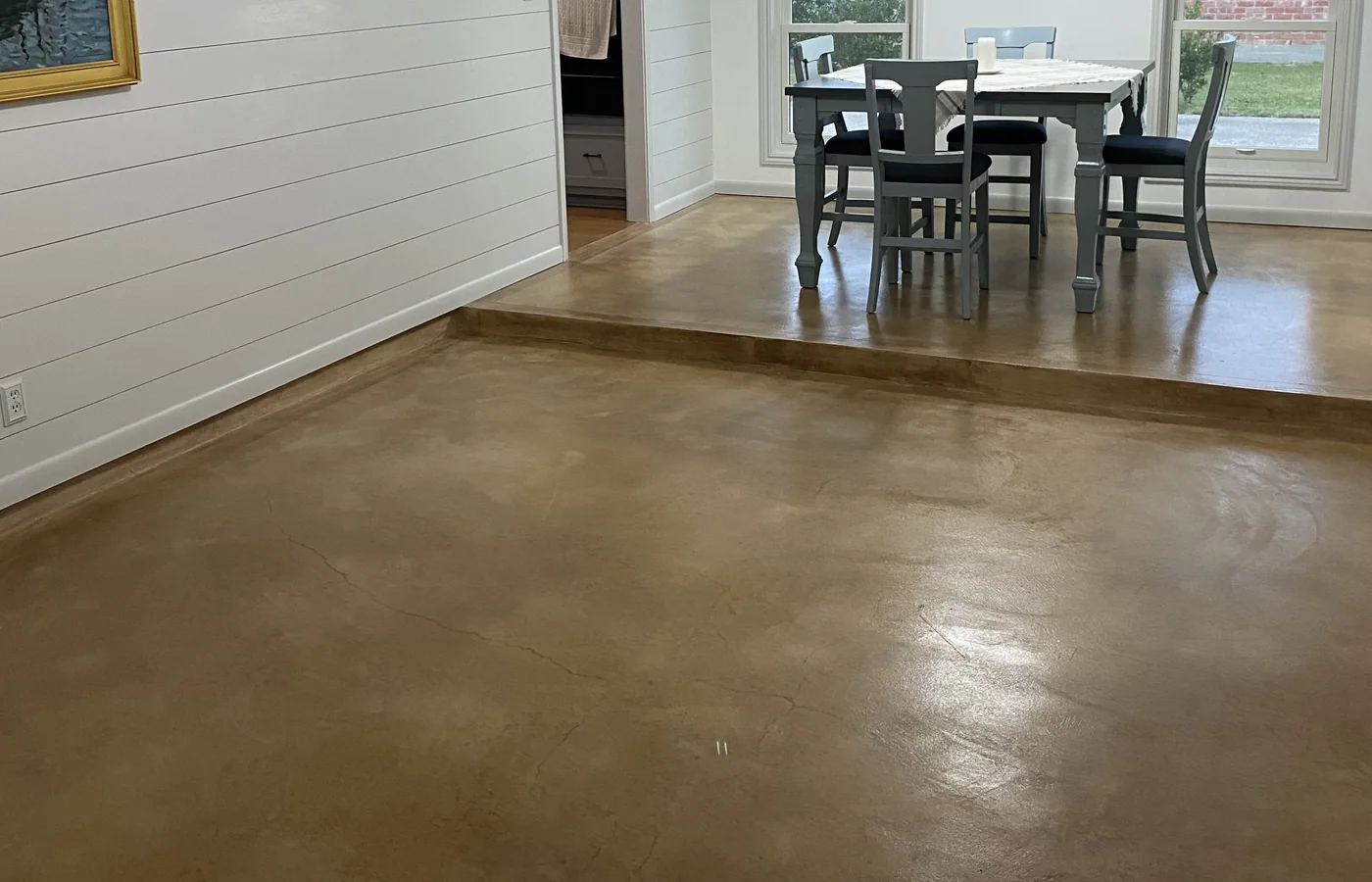
Staining can turn an ordinary concrete slab into a finished floor without covering up everything that makes concrete look like concrete. Color movement, mottling, scoring, existing variation and the way the slab accepts treatment all become part of the design.
The Concrete Is Part of the Finish
A stained floor is not a printed pattern or an exact digital color application. Existing porosity, prior use, repairs, surface preparation and the concrete itself affect how color develops. That variation is part of why stained concrete can feel natural rather than manufactured.
Project photography shows a color and design direction. It does not guarantee that another slab will produce the same tone, movement, sheen or variation.
Color Is Only One Part of the Design
Natural Mottled Finish
Keep the slab visually continuous and let tonal variation carry the floor.
Warm / Earth-Tone Direction
Browns, ambers and warm neutrals can work with wood cabinetry and traditional interiors while still showing concrete variation.
Scored Grid or Tile-Like Layout
Saw-cut or scored lines can organize larger areas and create deliberate geometry. The floor remains decorative concrete; it is not represented as actual tile.
Custom Layout + Transitions
Scoring can respond to doors, room changes, cabinetry, existing joints and other architectural lines.
Start With What Is Already in the Concrete
Staining works best when the slab condition and the desired look are compatible.
Worth evaluating:
- exposed concrete with a surface that can be prepared;
- existing natural variation you are comfortable seeing;
- cracks or joints that can become part of the floor’s character;
- areas where a continuous concrete finish fits the room.
May need another approach:
- heavy adhesive or coating residue;
- extensive patchwork or repairs that would remain visually obvious;
- contamination or previous treatment that interferes with preparation;
- moisture or slab conditions requiring a different floor system;
- a design goal that requires a more uniform or completely re-created surface.
Give the Floor a Deliberate Rhythm
Scoring can divide a large concrete field into panels, grids, diamonds or other planned geometry. The layout should make sense at walls, doors, cabinets, room transitions and existing joints rather than being dropped onto the floor as a generic repeat.
The Finished Color Starts With the Existing Surface
- Inspect + test. Review the slab, previous treatments, repairs, cracks, moisture concerns and design goal; use test areas when appropriate.
- Prepare as required. Clean and remove contaminants or incompatible material; mechanical preparation is used when the project requires it, not as a one-size-fits-all stain step.
- Plan scoring + transitions. Establish the layout around the actual room.
- Apply the color treatment. Build the approved stain/color direction while recognizing slab-to-slab variation.
- Protect + explain maintenance. Apply the project-specified protection and explain cleaning, wear and future maintenance expectations.
Sometimes the Slab Needs More Than Color
If the existing floor has extensive patching, adhesive shadows, incompatible coatings or other conditions that cannot be prepared into the look you want, a resurfacing or coating system may be the better direction. The evaluation should decide the system; the website should not force every interior slab into stain.
Plan for the Room, Not Just the Color
Indoor concrete still depends on the slab, moisture conditions, previous floor coverings or coatings, occupancy, furniture logistics and how the space will be maintained. Those details should be discussed before the color or scoring layout is finalized.
Common Questions
Will stain hide patches and discoloration?
Not reliably. Stain is translucent, so repairs and differences in the concrete may remain visible. If a more uniform appearance is the priority, another system may be a better fit.
Do office chairs need protection?
Rolling chairs concentrate wear. A suitable chair mat is strongly recommended, especially over stained-and-sealed or wax-maintained floors.
Can a stained floor be refreshed later?
Often, yes. Depending on the existing finish, maintenance may include cleaning, localized color touch-up and new protective coats or compatible floor wax.
Show Us the Floor You Have
Send a few photos, tell us what room the concrete is in, what you want to change and roughly how large the area is. We can start by deciding whether staining, scoring, an overlay or another finish direction makes sense for the slab.