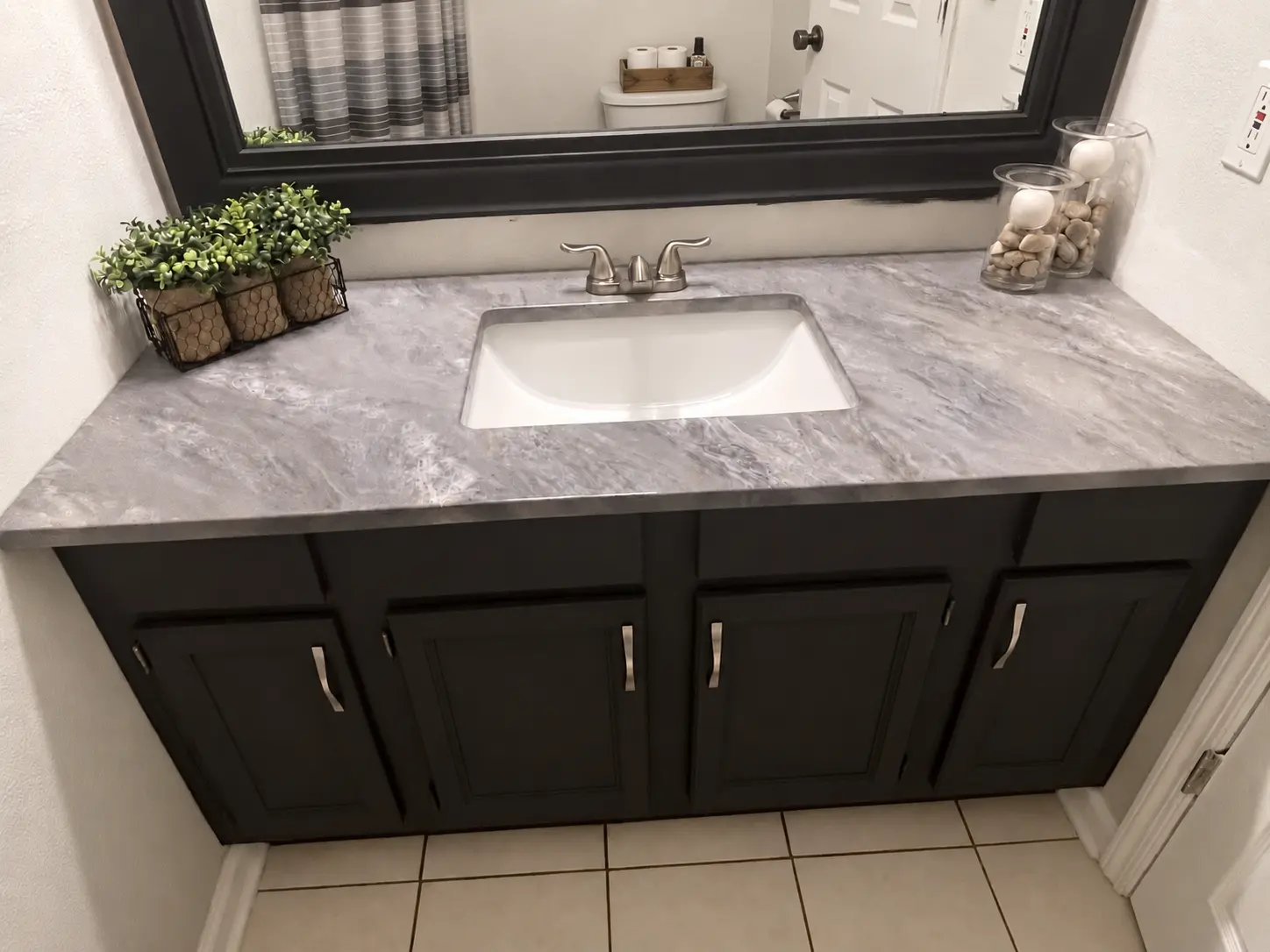
A custom countertop does not have to mean one material or one look. Depending on what is already there, the design you want and how the surface will be used, we can approach the project in three different ways: cast concrete, marbled resurfacing, or a decorative epoxy overlay.
The goal is to make that choice understandable before you ever request an estimate.
Choose the Right Countertop Approach
Cast Concrete
Best when you want the countertop itself built in concrete.
Cast concrete is the most architectural option. The shape, thickness, openings, overhangs and exposed edges are planned around the actual space rather than applied over an existing decorative surface.
It works especially well when the project calls for:
- a new custom countertop or vanity;
- an outdoor kitchen or bar built around masonry;
- custom sink or appliance openings;
- substantial exposed edges or thickness;
- a natural concrete look with hand-finished variation.
Because the countertop is being built as concrete, layout and support conditions matter before forming begins.
Marbled / Resurfaced Countertop
Best when an existing countertop is a good candidate for resurfacing and you want a new decorative finish without replacing the entire top.
A resurfaced countertop uses the existing surface as the starting point and builds a new decorative cementitious finish over it when the substrate and project conditions are appropriate.
This direction can create movement and tonal variation that reads more like hand-finished stone or marble while still retaining the character of a crafted surface.
It may be a good fit when:
- the existing countertop layout already works;
- replacement would create unnecessary demolition;
- the desired look is lighter, marbled or softly varied;
- the project calls for a decorative surface rather than a thick cast-concrete profile.
The existing surface still has to be evaluated first. Resurfacing is not a way to ignore a failing, unstable or unsuitable substrate.
Epoxy Overlay
Best when you want the strongest visual movement and a high-build decorative finish over a suitable existing countertop.
Decorative epoxy can create flowing marble effects, dramatic veining and layered color movement that would be difficult to create with a cementitious resurfacing finish.
It is commonly considered when:
- the existing countertop shape is staying;
- the design calls for pronounced marble or metallic movement;
- a glossy, high-build decorative appearance is desired;
- the substrate can be properly prepared for the coating system.
Epoxy is visually different from natural concrete. We show it as its own option so a customer is not left guessing whether a photo represents poured concrete, resurfacing or epoxy.
How to Compare the Three
| If you care most about… | Start by looking at… |
|---|---|
| A countertop built as concrete with custom thickness and edges | Cast Concrete |
| Keeping an existing top but creating a hand-finished stone or marble direction | Marbled / Resurfaced Countertop |
| Bold veining, flowing movement or a high-build decorative surface | Epoxy Overlay |
The right system still depends on the existing surface, support, exposure, daily use and the visual direction you want.
Variation Is Part of the Finish
These are hand-created surfaces. Concrete and resurfaced finishes can show tonal movement, pores and edge character. Decorative epoxy develops its own flow, veining and movement during installation.
Photos are useful for choosing a direction, not ordering an exact printed copy. Lighting, dimensions, surrounding colors and the way the material moves during installation all influence the final appearance.
Good Countertops Start With the Existing Conditions
Whether the project is new construction or an existing countertop, we start by understanding what is actually there.
- Identify the existing surface. Determine whether we are building new concrete or working over an existing top.
- Confirm dimensions + openings. Measure sinks, appliances, overhangs, returns, seams and adjoining surfaces.
- Evaluate support + substrate. Confirm the base is appropriate for the system being considered.
- Choose the finish direction. Compare the actual visual differences between cast concrete, resurfacing and epoxy.
- Build + protect the surface. Prepare and install the selected system, then apply the protection appropriate to that finish.
Design the Surface You Will Actually Use
Countertops see water, food, oils, cleaning products, cookware and daily traffic. Finish and protection choices should be made with that use in mind.
We do not describe any countertop system as maintenance-free, stain-proof, scratch-proof or heat-proof. Reasonable countertop care still matters, and maintenance depends on the system installed.
Where These Systems Fit
- Kitchen counters + islands: new cast work or resurfacing of suitable existing tops.
- Outdoor kitchens + bars: cast concrete works especially well with masonry and outdoor-living construction; other systems are evaluated for the actual exposure.
- Vanities: compact surfaces where edge shape, color and movement can become a focal point.
- Existing countertops: resurfacing or epoxy may avoid replacement when the existing substrate is suitable.
Common Questions
Do I have to replace my existing countertops?
Not necessarily. If the existing top is suitable, resurfacing or an epoxy overlay may allow us to transform the surface without replacing the entire countertop.
Is the marbled resurfaced option the same thing as epoxy?
No. They are different systems with different visual character. The resurfaced option is a cementitious decorative finish; epoxy is a resin-based decorative overlay with more pronounced flow and high-build movement.
Can you match a marble photo exactly?
We can use a reference to establish color and movement direction, but hand-created concrete, resurfacing and epoxy finishes are not exact printed reproductions of a reference photo.
Which option should I choose?
Start with the look you want and whether the existing countertop is staying. Photos of the current surface plus a few inspiration images are usually enough for us to narrow the appropriate system before an onsite visit.
Show Us the Countertop You Have
Send photos of the existing countertop or project area, approximate dimensions, sink and appliance locations if known, and one or two examples of the finish direction you like.
We can tell you which of the three approaches is worth exploring before you spend time trying to decode materials and product names yourself.